Posts

Showing posts with the label Switchgear & protection

Slepian Theory

Image
Slepian Theory This also know as recovery rate theory. when arc is struck between electrodes or CB contacts, the medium between them is highly ionised. If current is alternating in nature,at current zero instant, the ionisation is very less (residual ionisation). After zero crossing, the ionisation again increases and the arc is restruck i.e. Arc current again increases. The voltage responsible for restricking of arc is known as restriking voltage. If dielectric strength of the medium is built up sufficient during current zero instant, it will prevent the arc to restrike i.e. current won't flow after that current zero instant.  This can be described as a race between dielectric strength and restriking voltage. If the rate of rise of dielectric strength is more than rate of rise of restriking voltage - the arc will not restrike.  But if rate of rise of dielectric strength is less than rate of rise of restriking voltage - the arc will restrike. The concept is elabor...

Minimum Oil Circuit Breaker (MOCB)

Image
Minimum Oil Circuit Breaker (MOCB) The supporting, current interrupting and top chamber are made up of porcelain. Hence, clearance between live parts and enclosure is small and requires less quality of oil, hence the breaker is called as Minimum oil circuit breaker (MOCB).  The chambers are completely filled with oil. The upper chamber of oil is does not come to lower. The fixed contact is enclosed in the quenching chamber. Moving contact makes sliding contact with lower fixed contact. The operating rod is operated by operating mechanism.the three poles are operating simultaneously. The voltage ratings are from 3. 6 kv to 420 kV.  Wnen the contacts carrying current are separated in the oil the arc is developed. The heat of arc causes decomposition of oil and gases are formed. These gases expand due to heating of arc. The gas flowing near the contact zone causes cooling and splitting of the arc and extinguishes the arc. After the arc is quenched at ...

Fuses

Image
Fuses A fuse is a Short piece of metal inserted in the circuit, which melts when excessive current flows through it an thus breaks the circuit and protects the equipment.  Materials of fuse:- Most commonly used materials for fuse elements are lead, tin, copper, zinc, silver. Silver is used now-a-days. It is a best fuse material.   Important terms related to fuses:- Current rating of fuse element:-  It is the (r. m. s. value of) current which the fuse element can carry without over heating or melting. Fusing current:-  It is the minimum current at which the fuse element melts and disconnects the circuit protected by it. This value is obviously more than cuurent rating.  Fusing current depends upon the material of fuse element, length, diameter and type of enclosure.  The value is always greater than one. The smaller the fusing factor, the greater the difficulty in avoiding determination due to overhea...

Induction type Over Current Relay

Image
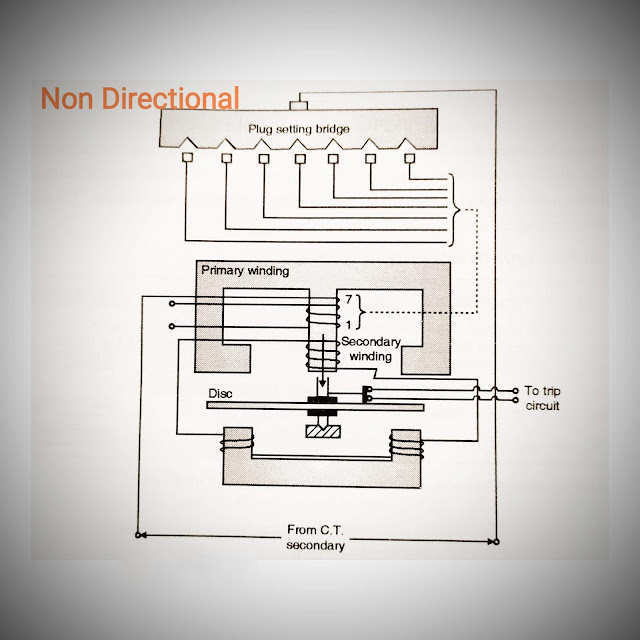
Induction type Over Current Relay Induction type Over Current Relay(Non Directional) :- Construction:- The relay works on induction principle. Actuating quantity is current (from CT secondary). The primary winding is connected to secondary of C. T. in the line to be protected. An aluminum disc is pivoted which moves freely between two electromagnets. The primary is tapped (1...... 7). Tne tappings are connected to plug setting bridge so that number of active turns on relay can be changed and desired current setting can be obtained. Secondary winding is connected to lower magnet by series connection. Due to induction principle e. m. f is induced in secondary due to current in primary. The torque exerted on the disc is due to interaction of eddy-currents in the disc and flux produced by upper and lower magnet. The two fluxes have phase displacement. The spindle carries moving contact which bridges the two fixed contacts which are connected to trip circuit. T...

Desirable qualities And Term's of protective Relaying

Image
Desirable qualities And Term's of protective Relaying Selectivity and Discrimination Speed Sensitivity Reliability Simplicity Adequateness Economy 1. Selectivity and Discrimination:- Selectivity  is the ability of the protective system to select correctly the faulty part of the system and disconnect the faulty part without disturbing rest of the system. And in order to provide selectivity to the system entire system is divided into several protection zones.  Discrimination means 'identifying the difterence between'. This property of protective relaying enables it to distinguish between the nomaal condition and abnormal condition. The protective scheme should operate during abnormal condition and notduring normal condition. If Fault occurs at F1 the CB1 only should trip and other system continues to work. Similarly for F2 both CB3 and CB2 should open. Thus, the protective relaying should isolate only the faulty part of line without distu...